Labels

Showing posts with label Reviews. Show all posts

Textual Analysis - The Scarecrow Game App


This video is closer to a short film than an advertisement, lasting three and half minutes. The trailer itself is in fact a high quality 3-Dimensional cinematic, the footage of which isn't present in the game, similar to promotional cinematics used for upcoming disney or pixar films. As rare as app game video adverts are anyway, having the trailer as a full cinematic indicates that the company that's made the game is well-established, and also has money enough to use more expensive advertising techniques.

There's no indication to begin with however that the trailer is promoting an app game for a long time, as no actual game footage is shown until the very end of the clip, where there are smaller screens showing snippets of gameplay, as well as the trailer's scene zooming out, revealing it to be playing on an iPad. There is information shown at the end of the trailer on what platforms the game will be coming to. One thing to mention however, that I didn't realise before, is that this game has another shorter trailer that's devoted to the game's content, and there is also a video detailing where the concept of the 'The Scarecrow' came from. Both were made by the same person who uploaded this trailer.

The game and advert are in fact made by a catering company, called Chipotle, who specialise in Mexican Grill and, more importantly, have a policy that 100% of the food stock they import comes from farms that grow their crops and livestock naturally without artificial interference. They designed the game to tie in with this policy, quite possibly as a different way to gain income to expand their cause.

In terms of Mise-en-Scene the setting is shown to be out on a vast, dry, western-esque prairie, where a huge factory has been built this factory farm is called Crow food, and is run by robot crows, and serves as the supplier of food to the entire world. True to the game's title the workers in this factory are not humans but scarecrows, which enables a strong association with farming, as scarecrows are a stereotypical icon for farms growing crops. It also goes against traditional convention, as scarecrows are known to scare crows away from crops, whereas here they're working under them.

The scarecrow referred to in the game's title refers to one particular scarecrow that the trailer revolves around. This scarecrow does maintenance around the factory farm, although it's made clear through the shots that his job is making him hate himself, the reason of which is shown with the shots in the trailer

Due to the Chipotle's ideals about its food, the trailer deliberately makes use of shocking imagery in the factory farm, such as having a chicken casually blown up to a overly plump size with an injection of growth hormones from a robot. A similar one is shown later with a stack of tiny metal boxes, out which living cow's heads are showing. The boxes are shown to be vibrating, as well as having inserted into them, but nothing can be seen of what's going on inside.

Whilst these images are shocking in their own right, the context they're used in is also interesting. Both shots are shown be taken from inside structures that otherwise couldn't be seen into, but have a piece of their outer structure loose or fallen off. These structures come in the form of adverts or posters for the factory, which glamourously portrays their food as naturally grown and 'farm fresh'. Their contents are only shown when the scarecrow is repairing them, and looks in both times before fixing the structure and hiding its contents once again, as per his job requires.

Along with other shots showing the inhabitants casually consuming the factory's foods en masse, it's implied that the inhabitants aren't aware of the atrocities going on within the factory, and another key thing is that the trailer really revolves around a character concealing them as his job indicates, although he may not openly enjoy it.

From these images and shots you can put together the pieces. The trailer is in fact about campaigning for Animal Rights and also to raise awareness of the horrible techniques used in factory grown livestock. The hypocritical advertising represents false promises about the foods, to put the public's minds at ease. The blissfully ignorant citizens represent us, the consumers in real life, who buy and eat factory produced food without a thought as to how it was made, and the scarecrow workman concealing the factory's secrets from prying eyes further represents this ignorance that we have towards factory foods.

The end of the clip does however represent how these techniques can be stopped and changed, when the scarecrow returns home and its shown that he has vegetables growing there. The following day he travels to the city and sets up his own food vendor alongside the factory, where he prepares vegetable based dishes and the inhabitants start to take an interest one by one.

One final thing to mention is the sound used in the trailer. There is very little diegetic sound used in the clip. The only sources of diegetic sound come from the sounds of machines in the factory, and the shrill cries of the robot crows. The key piece of sound comes from a non-diegetic song playing for the duration of the advert.

The mood of the song changes as the trailer goes on, to reflect the change in the mood of the trailer as well. I starts off sounding rather dubious and grim, when the factory is shown from the inside as the scarecrow travels through it, setting the mood of the factory itself. It then strengthens in tone as the scarecrow goes about his job, indicating a stronger message and stronger imagery present within the trailer. It then changes in key considerably when the scarecrow returns home and starts up the vegetable business, becoming far more positive and glorious sounding.

The lyrics of the song, when listened to carefully, have deep meaning to them about the advert's portrayals. It partially talks about how imagination is prettier to look at than what happens in reality, which ties into the facade created by the factory about its foods. It also talks about how it isn't impossible to see the ideal world that you dream of, and that changing the world really isn't difficult at all, which ties into the Scarecrow taking action against the factory, by starting up selling vegetable goods.

Textual Analysis - My Little Pony Game App


The trailer lasts for slightly under a minute, which is around the time that most game adverts last. The trailer is showcasing an app game released for the TV and toy franchise My Little Pony.

The trailer takes advantage of the franchise's success and uses a motif - the instrumental version of the theme song from the TV series, as the non-diegetic soundtrack for the trailer and also uses some footage from the show's opening to start the advert off and clearly show what the ad will be about. The feeling of the motif, as well as the colourful and cartoony style of the ad, gives the impression that the game isn't overly serious and is made more to be fun.

The very start of the advert has the logos of each of the different companies involved in the app's creation, indicating at the start that the add will be game related. All other footage shown is taken directly from the game. The shots include the environments and graphical style of the game, the style of gameplay, and the characters within it. The features, from what is shown, seem to pay homage to original themes and elements contained within the TV show, especially since the fist few seconds of the  show's opening is used, which implies that the game is in fact a counterpart to the show itself, and not the franchise in general.

There are no spokespeople or real actors shown or heard in the ad to present the features of the app game. The only sound in the advert comes from the non-diegetic soundtrack, along with the diegetic sounds of the app itself. The information instead is shown through on-screen captions, explaining the functions of the app and then showing footage, from the game, to back up the captions.

In each instance the footage shows one of the franchise's major characters showcasing the function as either the playable character or a character involved in the function, enhancing a fan's desire to buy the game, so as to play as their favourite characters.

Finally, at the end of the video, the trailer makes it clear what platforms the game will be coming to, with a final message saying that the app will be available on iphone, ipad and android, as well as having trademark and copyright small print at the bottom of the screen before finishing.


My Little Pony Youtube Commercial - Original Uploader

Textual Analysis - NBA Game Time App


By advertising standards, this ad is reasonably short, at 30 seconds for the entire ad. As such there isn't too much to cover in the ad, just the format, what it features and what it doesn't, the demographic that the ad is aimed at, and the clarity of the ad's message.

The ad puts on a full promotional and informative style, using narrative from multiple people in the real world to demonstrate its point, all of whom show genuine enthusiasm when they're talking about the app. The only non-diegetic piece of narrative comes when the footage of the app being used is shown. The people in turn each talk about the functions of the ad: it keeps track of the 30 main NBA teams, and their scores and statistics, alerts you to games that are showing, and provides fast access to watching the games themselves, or so it states.

Not much actual footage from the app is used. There is only one quick look at the app itself, with someone viewing a basketball game on their phone via the app. The video does however make it clear that the ad is promoting an app for NBA Game Time, with the promotional catchphrase 'pledge appllegiance', and then stating that it's referring to NBA Game Time through the dialogue. The trailer also make's sure to show the app's icon, where the app can be bought, and what platforms it can be used on, at the end of the video.

The ad also covers many bases in terms of demographic representation. The people shown in the ad include males and females, along with black and white people. The main age demographics are those that are generally associated with having smartphones of their own. As such there aren't any really young or old people used in the promotional trailer. Some of them are shown to be teenagers, some look to be students or young adults, others slightly older.

The ad also seems to primarily target middle class people with the spokespeople that the ad uses. Basketball generally isn't associated with upper class people, and as such It isn't just aimed at people who are into sport or leisure either, as not all of the people are shown to be sportsmen. This indicates that there is definite diversity among the fans of the NBA, and it also expands the target demographic for the advert to more people.

There's also no shortage of different locations represented. The spokespeople shown in the ad were shown in a variety of places, a café, a bowling alley, the exterior stairway of a block of flats, in the middle of a street road, and within their homes. This an indication that the app can be used in any location, and by anyone, as mentioned in the above paragraph.


NBA Youtube Commercial - Original Uploader


Game Review - Temple Run


Temple Run
Developers: Imangi Studios
Genre: Endless Runner
Platforms: iOS, Android, Windows Phone 8

I was contemplating various other games to use as my third review. Angry Birds and Candy Crush were easy choices, but they but use the same level based gameplay style. I wanted to cover an endless runner because of how popular and successful they are, but it wasn't till I did the questionnaire and looked at the results that I decided which one I'd do. Temple Run scored almost as high as Angry Birds as a game people had on their phones. As such this is the next and probably last game I'll be analysing before this project ends.

As a play-style endless runners are one of the oldest and most used gameplay styles to date, so what's different or well done about Temple Run that makes it successful?

Visually Temple Run is more impressive than most other successful games. It shies away from cartoony or technicolour graphics, and instead uses comparatively detailed textures for its environments, which creates a different, more exciting and mature and realistic vibe for the game, as opposed to the more childish graphics of Candy Crush or Angry Birds.

It's also 3-Dimensional and uses a third-person camera compared to other endless runners that are 2D side scrollers. It can be argued that compared to console games the graphics are rather pixelated and grainy, and that the animation and shapes lack the cleanness and crispness that more recent games possess, but for its age it's still a decent looking game.


Moving onto gameplay itself, your default playable character is an explorer who's running in true Indiana Jones style from a bunch of hellish looking black creatures, who're chasing him because he's stolen their ancient relic. Your job is to keep him alive as you navigate the temple pathways to evade his freaky pursuers, even though no visible end will ever be in sight.

It's not a clear path though; the path is full of twists and turns that require quick reactions to manoeuvre and there are multiple obstacles and death drops that require jumping over or ducking under. Also, contrary to what happens in the real world, the characters running gets quicker as he's kept alive for longer, so obstacles get harder to avoid, and you have to be more precise with every move you make.


With the 3-Dimensional level style, the way the character is controlled becomes slightly more complicated. The path you're running on is always a single path, but you're not confined to running along a set line.

The game makes use of the tilt detection mechanism that smartphones have, and this allows you to move the character to the left or right of the temple path, although sometimes can lead you to send him of the edge when the path has no sidewalls.

Finger sliding on the touchscreen is instead used to make the character jump, duck, or to make the character demonstrate super-human turning ability when the path swerves of at sharp right angle either left or right.

Depending on the obstacle, it is possible to take a hit and not get caught by the creatures following you, but if you make another wrong move afterwards they'll be onto you in a secind. Even so, as you play the game your cause of death is far more likely to be the scenery than it is the creatures following you.


So in an endless runner like Temple Run, you know that there's no end of level; no way of actually completing it. By itself that would be very boring and more than likely you wouldn't keep playing for very long. So what other mechanics exist in this game to make people want to pick it up and play it again?

First of all there is the scoring and leaderboard system. The vast majority of app games out there have a scoring system in them and Temple Run is no different. Like most endless runners higher scores are earned the longer you run for, and your high score is then recorded and shared on a main leaderboard.

You can also see the scores achieved by your friends when they've played the game. Furthermore when you play the level, the names of your friends will appear above the course, at the point they reached on their furthest run, and it can be satisfying running under those names and pressing on with added smugness.


The other key element is coins. You find these in abundance throughout the level as you run. They come in gold, red or blue depending on their value, and they're most commonly found in long rows on either the left, right or centre of the path, although sometimes they require jumping and ducking to obtain as well. The higher value coins only appear after making it past a certain point, which serves as an incentive to keep surviving.

Often these coins will be the big reason for using the tilt mechanic as you try and collect as many as possible, and often times these will also be the reason you make a mistake, when your eyes are drawn away from the obstacle laden path by these glittering prizes.

The coins add up over time and as you progress in the level a score multiplier increases as more are collected. If you trip however and allow the creatures (apparently they're demon monkeys) to gain on you the multiplier reverts back to base and the work has to be done from scratch.


These coins are your currency in the game. When enough have been collected you can use them to unlock power-ups to make the levels easier. Once unlocked the power-ups start randomly appearing in the levels and its always a welcome sight when one appears, and annoying when you end up missing

Once you've initially bought a power-up you can then invest more coin into upgrading them to increase their effect or their duration. Power-ups include a temporary magnetic field that draws coins to you without the need to tilt, gaining invincibility from obstacles for a short time, and gaining a sudden sped boosts that rockets you forward in the level a couple of hundred meters.

You don't just have to stick with the default character either. There are also additional characters that can be unlocked by investing some of your coins into them. They're expensive though, so a good deal of play is needed.

The game also isn't without the choice of in-game purchases. If you're really impatient for coins and don't feel like getting them inside the level, various coin amounts can be purchased for a reasonable amount of money. There is a lot of unlockable content, and collecting enough coins to get it all can be tedious and hassle-full. The purchases provide a solution to that, if you're willing to give a little in return.

Temple Run combines all of these elements together, and it seems they've worked supremely effectively. is both successful and influential as, since its release, its style has been very similarly replicated and adapted in other app games, most notably Subway Surfers, another commercially successful app game whose game elements and mechanics are remarkably similar to Temple Run's.

Since its original release in 2011 on the iOS Temple Run has also become a game franchise in its own right and now has a sequel game: Temple Run 2, as well as two film adapted versions based on Disney's Brave and Disney's Oz the Great and Powerful.

The game really grows on you quickly, as I found out when I played it for the sake of writing this analysis. Consistently Temple Run is critically acclaimed as an very good game, and although its not without flaw, it does its job as an app game. It's addictive, it's exciting and it's fun.


Temple Run Logo
Image 1
Image 2
Image 3
Image 4
Image 5
Image 6
Image 7
Screenshot Location

Game Review - Angry Birds


Angry Birds
Developers: Rovio Entertainment
Genre: Puzzle
Platforms: iOS, Mac, Mac OS X, Android, Windows Phone, Blackberry Tablet OS, Blackberry 10, Facebook, Playstation Store, Google Plus, Google Chrome, WebGL, HP webOS, Samsung Smart TV, Maemo, MeeGo, Symbian^3, Series 40, Bada, Roku


I think there is something we can all agree on here. Whenever you think of app games one of the first games to pop into your head is Angry Birds. A good amount of people would all agree that this game, and its rapidly expanding franchise, has become the face of app games, much like Mario is for Nintendo. Therefore it would be somewhat foolish not to look at this game when an app game is what you're trying to create, so in this review I'm going to cover the original Angry Birds, where it all began for this globally successful franchise. One look at it and it becomes clear that the game takes a turn for the cartoony. The environments and characters look like they were originally made as doodles and then copied and pasted onto the game's template. In short the graphics are very basic, but the game makes up for this by experimenting with the game objects and manipulating them in new and interesting ways and forms. The cartoony graphics also give the game a more fun look, and the style makes the objects placed into the game clearly prominent and identifiable.

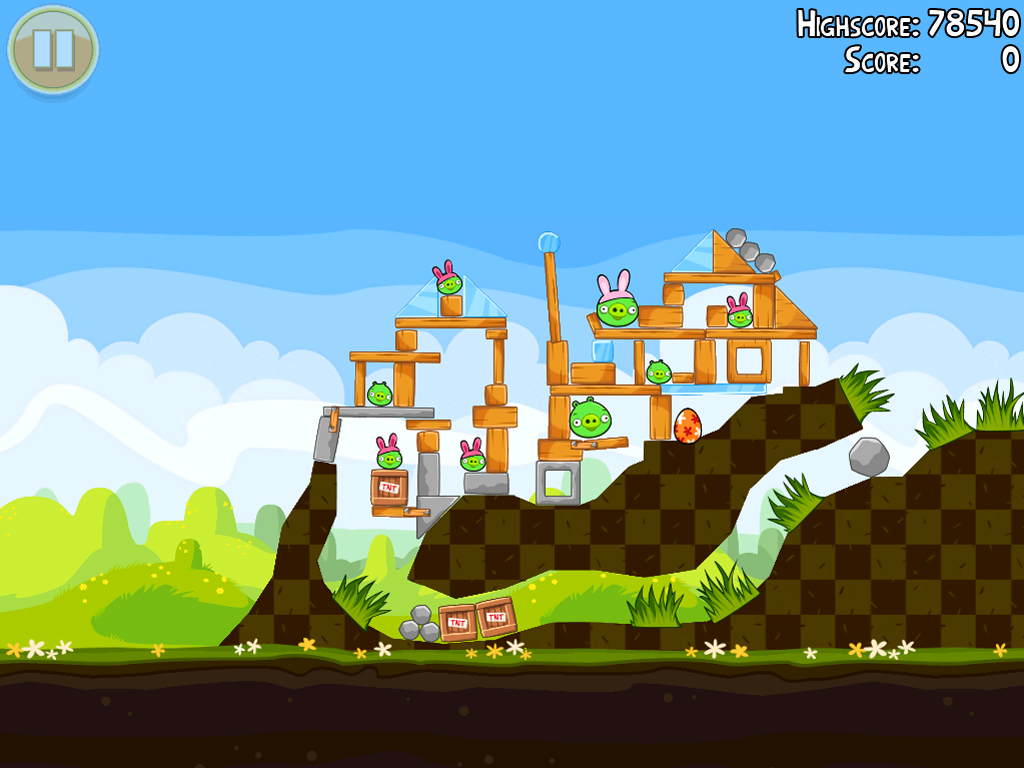
In terms of gameplay itself you play as a group of cartoony looking, plump, limbless and (as the game title suggests) very annoyed looking birds, trying to bring down a group of cartoony looking, plump, limbless green hogs. The aim of the game remains constant throughout the levels. You control an enormous slingshot, where the birds turn themselves into your ammunition. The goal is to bring down a structure, made of various breakable objects, to take out the pigs seeking shelter inside. Upon taking damage both the birds and pigs accumulate various bumps and bruises before finally poofing out of existence in a puff of feathers, or in the pig's case a decent amount of points. Your ammunition is however limited to about 3 to 6 shots so the game encourages tactical use of the shots to reach the pigs and complete the levels.

Sounds simple from the front, and it is at the start of the game. Once you get into the game and manage to clear a few levels however, the structures become more ingenuitive in their construction and can't simply be brought down by any regular shot. Different varieties of birds, easily recognisable by their different colours, are also added into the game which have varying effects ranging from dropping explosive eggs, to splitting into smaller birds and battering the structure. The game requires you to be strategic about how to use the different birds and where to aim on the structure to achieve the maximum possible damage. In the later levels, tilting the birds trajectory ever so slightly can make the biggest difference in the effectiveness of the shot.


The game's layout is similar to Candy Crush in that it uses levels rather than a single infinite stage. It also utilizes a scoring and rating system, having points being accumulated for destroy pieces of the structure, taking out the pigs themselves, which are required for level completion, and also how many birds haven't been used after all of the pigs are exterminated. Depending on how well you do, you get awarded up to 3 gold stars on each level, as well as a very happy looking bird appearing beside it to show the level's completion. Unlike many popular app games however Angry Birds doesn't have a built in leaderboard system, or a means to directly compare your high score with others in your social circle. Instead there is an online leaderboard where total scores within each game can be submitted onto a single league. This enables the chance to aim for high scores among the global rankings for the game.

Angry Birds is also not without its additional content. If you're having trouble on a particular level you have the opportunity to purchase various power-ups and skills to aid you in completing the levels. These include mega sizing the slingshot to increase the shot's power, range and height, causing a small earthquake that shakes the structure and occasionally dislodges pieces and pigs, and making the bird being fired to grow bigger and stronger. You are given a set of power-ups to use at the start, however once they are used you have to purchase more if you wish to use them again. One particular power-up - The Mighty Eagle, which is purchased once and afterwards becomes permanently available, also unlocks an entirely new challenge within each level; the goal being to use the power-up to destroy everything in the stage. For each stage this is accomplished in you receive a feather to that you've done so, which also gives incentive to come back and redo levels and have fun obliterating everything within them. With later updates to the game a new way to earn power-ups has become available. Once per day when a level is started a slot machine appears before the level starts and grants you a random power-up that goes straight to your inventory, enabling power-ups to be obtained free of charge, albeit randomly.

Angry Birds also has a tremendous amount of levels. When it was first released there was a single episode containing 3 worlds. Each world has 21 levels, creating a total of 63 levels to play. Since then the game has been repeatedly updated, and now contains 10 episodes and a grand total of 420 levels to complete. In short you won't be done with this game in a single day, or even a single week. This game is packed with content and each level contains a new creative structural layout that's begging to be toppled. The levels do require being completed in order to be able to continue playing an episode. It is however possible to start any episode at any point, regardless of whether the previous episode has been completed. It's possible to complete episode 9 before episode 1 if so wished, but the levels for each do require completing in order however.
The major point however about the characters within the game, as well as the play style is that they're iconic and also memorable. Mario from the Super Mario franchise, Pikachu from Pokémon, Sonic from the Sonic the Hedgehog series. All of them are iconic, as too are the Angry Birds from this game. Being iconic is something that all commercially successful games have managed to do, though it's difficult to completely explain exactly what it is about them that makes them iconic. Perhaps it's how simple the characters actually are, it may be due to the way that they manage to change the general image of the things that they are based off.

Whatever the trick is, it manages to make them so. Of the hundreds of Game franchises on smart phones or not, Games that do that are few and far between. Angry birds is one of those few. It has everything needed in an effective app game, iconic characters and cheery and cartoony setting, packed with content that all uses the same formula but produces new styles each time and incentive to complete each level the best that is possible and compete with others for leaderboard spots. It's the ideal that app game, and truly deserves to be successful.


Profile Information and Angry Birds logo
Image 1
Image 2
Image 3
Image 4
Image 5
Image 6
Image 7

Game Review - Candy Crush Saga


Candy Crush Saga
Developers: King
Genre: Puzzle
Platforms: Android, IPhone, IPad, Facebook

This was an easy first choice for me. If you want to design an app game, then what better game to start analysing from than the one that inspired me in the first place. That's right; this first review is on Candy Crush Saga. By far and way my favourite out of the menagerie of various app games that I've caught a glance of over people's shoulders.

This game from the front looks very familiar. It's another take on the age old match-three gameplay style seen in games like Bejeweled, and countless others that each bring their own look to the playing style. Candy Crush, at least at the beginning, also fits into this common style. This time around the objects that require lining up are multicoloured pieces of candy, hence the name Candy Crush. The scoring system is implemented into it as well, allowing the chance to aim for high scores and amass some sweet combos (pun fully intended) by clearing candy in a way that doesn't harm your teeth.

Common of a smartphone game, the graphics are simplistic and clean, with a definite turn towards the cute and cartoony. One look at the map for the game is enough to show you that the makers put a lot of consideration into the graphics for the game to make it look amazing. They're also very vibrant and bright, giving an all-round cheerful mood to the game. The candy pieces themselves are a spectrum of rainbow colours very reminiscent of real candy, whose bright mix of colours always catches your eye as you walk past them on display in shop windows, and then makes you want to go and buy them yourself. Clearing the candy from the board also gives you an immense feeling of satisfaction, especially when you manage to inadvertently start a combo of candy alignments, and you find yourself watching as rows of candy disappear from the board with a satisfying poof one after another, and you find your score suddenly becoming double what it originally was.

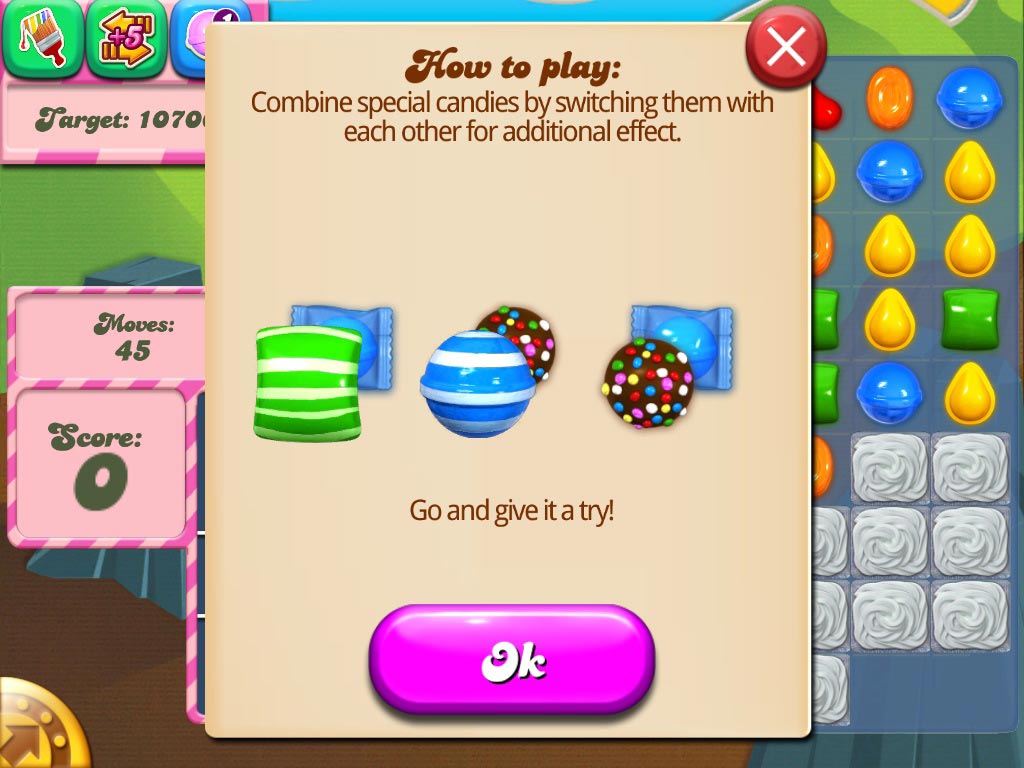
If however you're lucky enough to find a chance to match a row of 4 pieces of candy or more, or even mange to clear two rows of the same colour candy in a single switch then you'll find that what is left is something that looks a little different from the vibrant technicolor candy pieces that litter the grid, and this is one of the things that makes Candy Crush unique. The match three style implements several additional ways to clear the board of candy by adding bonus candies that can be obtained by doing more than just making a row of three. These candies have various helpful effects such as clearing a whole row/column of candy, or destroying every candy on the board of a single colour, and that's not including the various combos that can be created by combining these bonus candies.

As well as these special candies, the game also implements entirely new sweet based elements as the game progresses, that serve as elements to make the board harder. These include meringue squares, that serve as blockers, but can be destroyed by lining candy up next to it; liquorice cages, which have a candy trapped inside that can only be released by making the caged candy a part of a row of the same colour; and chocolate squares, that work in the same way as meringue but overtime spread and fill more spaces on the grid if left unchecked. The game also makes excellent use of the grid itself to increase the difficulty of the levels, by modifying the grid to make some areas difficult to reach or make rows in, especially when additional stage elements get added into it too.

Unlike a lot of other addictive game apps that use a style of gameplay that involves a single infinite level, with the goal being to survive for as long as possible and try to break other high scores, Candy Crush Saga breaks the mould and goes down the same route that Angry Birds took; using a level/mission format where a stage needs to be completed before progression is possible. Candy Crush Saga at base already has a staggering 155 levels, without counting any updates that came after its release, that require being completed in order. These missions also vary in what is required for their completion, lending itself to a less singular way to play that players could otherwise quickly grow tired of. Classic ideas include obtaining a set amount of points in a certain amount of moves, while others implement a timer without any move restriction. Some new mission types introduced in candy crush incorporate elements from the game itself, involving clearing candy to bring fruit to the bottom and off of the board. Another one that becomes very frequently used in later levels is clearing squares of jelly from the board in a set amount of moves, which can be done by destroying rows of candy over the top of it.

Another similarity that the game shares with other stage based games is a grade system of up to 3 stars, that are awarded depending on how well a level is completed. In Candy Crush the stars are obtained purely based on the amount of points amassed during the level which gives more incentive to come back and revisit levels, so as to win more stars that weren't achieved the first time a level was played. The second incentive to keep playing comes in the form of your score. Being able to compete with friends over who has the highest scores that has practically become a staple for app games now. Candy Crush is no exception to this. The game is able to find other people that you know on Facebook that also play Candy Crush and display their score in a highest to lowest order, and also shows where you place on the leaderboard. This provides additional incentive to keep replaying levels, so that you can get bragging rights on having the highest score out of your friendship group. It's another very satisfying feeling seeing you're name at the top of a leaderboard on a particularly hard level.

In terms of cost Candy Crush is rather sneaky. At the start the game is free to download, which enables you to actually get a good taste of what the game is like, and more often than not become immensely drawn in by this game's incredible addictive quality. Because Candy Crush Saga is a mission based game, which makes failing a level possible, the game incorporates another element; hearts, which you are initially given five of to play the game with. As you play through the game you are bound to fail missions and lose hearts in the process, until eventually you run out completely. When this happens you are rendered unable to keep playing until your hearts return, which takes a considerable amount of time, especially during later levels where it's easier to lose lives. As well as that, once you've reached a certain point in the game, you are rendered unable to continue until you've unlocked the means to access the next part.

In both instances the game presents the a couple of options to getting round the problem. For the unlocking the stages the options are to receive help from three different friends on Facebook which may be easy to do or hard, or by clearing a set of three different quests (missions from past levels that require completing an objective with a high enough score) each of with require an entire day before the next quest can be completed. Regaining hearts also has the option of receiving help from Facebook friends, as well as using Facebook credit if you play the game from Facebook itself. The final option for both of these however is simply to purchase them, at around 70p each, which doesn't seem like much until you find that you start to do it more and more. There is also the option of purchasing special unlockable candy known as boosters, which can be used in the levels you select them for, and can be immensely useful in the harder levels that are difficult to complete normally.

Ultimately Candy Crush manages to get you to give up your money in order to keep playing it, however more often than not the little amounts that you do spend are inconsequential because of what you're spending it on. Match-three games are naturally addictive, and addictive is something that Candy Crush is first and foremost. The lighthearted and bright atmosphere of the game, with its cute and colourful designs keep you in high spirits whilst playing the game, which in turn makes you come back to see more of it. The playing style of Candy Crush is by no means basic, and the levels incorporate loads of cool and clever trick and treats to improve the gameplay and turn the basic match-three playing style into something original and undeniably fun to play. Candy Crush Saga is well deserving of the popularity it has obtained and is a prime example of how app games are designed to be played.